

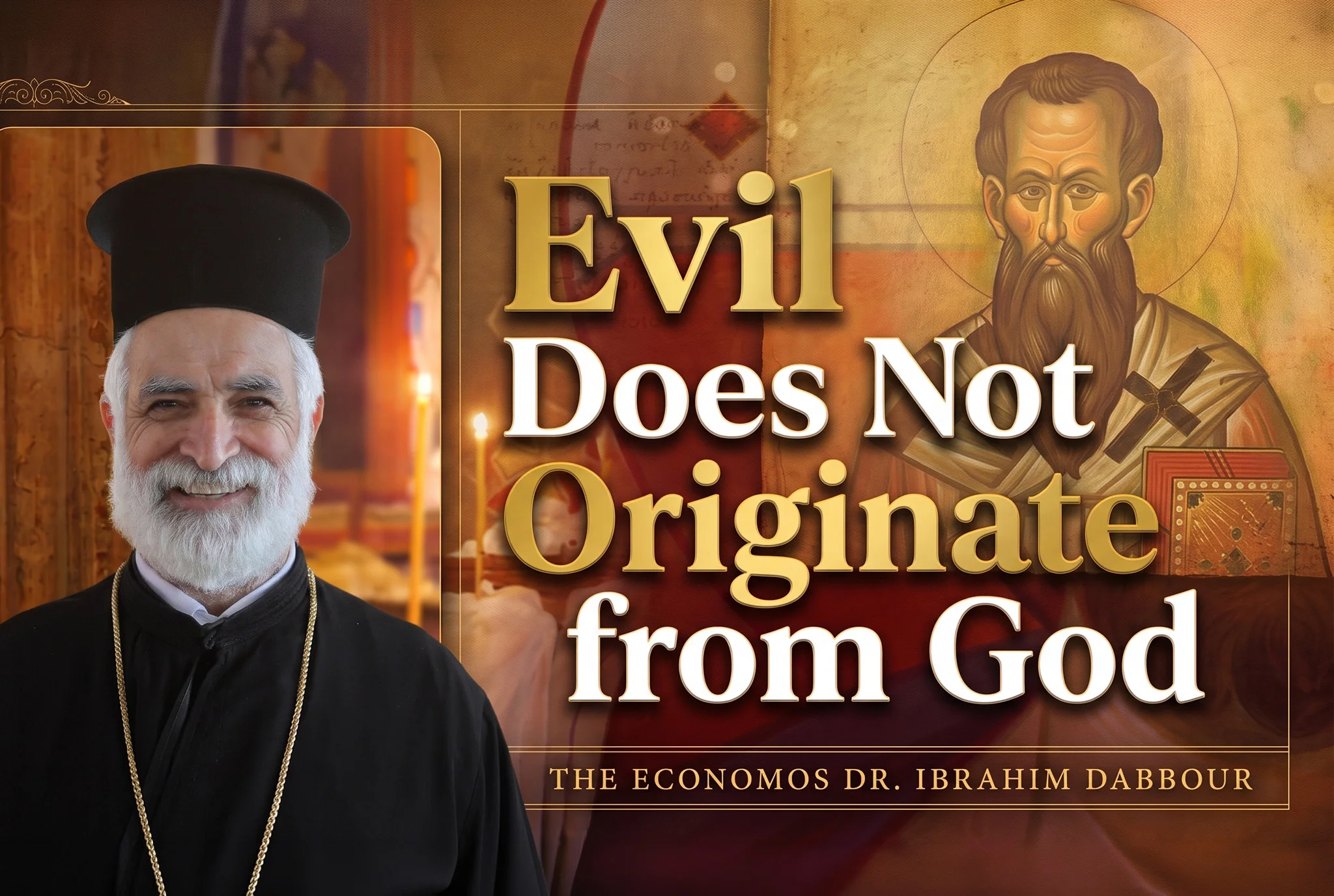
Evil Does Not Originate from God
By Saint Basil the Great
Introduction to the Book
In the name of the Father, and of the Son, and of the Holy Spirit, the one God. Amen.
Our beloved children,
After the Fall, and having turned away from God, humanity became lost and wandering in this world, living amid pain and sorrow, having lost the close communion with its Creator that it had enjoyed in Paradise. Nevertheless, the longing for God did not fade from the depths of the human heart. Rather, humanity continued to yearn to behold its Creator and to strive spiritually to regain the peace and stability, both spiritual and physical, that it had lost.
In this life, the human person faces many problems and worries, some social, others spiritual, and still others material. One tries to adapt to life’s circumstances and changes, yet often finds oneself moving from one sorrow to another, and from one worry to the next. This is because one makes oneself the centre of one’s life and relies on one’s own strength and self, allowing pride and arrogance to lead one far from the purpose for which one was created.
Perhaps the greatest lesson a person needs to learn is that turning away from life with God is not merely one problem among life’s many problems; rather, it is the greatest concern and the deepest cause of every disturbance within the soul. The human person does not find true fulfilment in oneself or in the riches of this world, but in returning to God, the source of life, peace and salvation.
For this reason, the Lord God deals with humanity through mercy and divine providence, disciplining us in many ways, not out of a desire for our destruction, but in order to awaken us from our heedlessness, turn us away from the paths of error, and lead us once again to the knowledge of God and life in communion with Him.
This is what Saint Basil the Great explains in this book. With a paternal spirit and profound spiritual teaching, he reveals to us God’s ways of disciplining and guiding humanity, the nature of the trials and afflictions He permits in our lives, and how all these things, when accepted in faith, can become a path leading us to God.
Thus, the highest aim is not merely for a person to be freed from the problems of this life, nor to attain temporary earthly comfort, but to discover the path that leads one back to one’s original purpose: life with God.
The pages before us are not merely a teaching about trials and afflictions; they are an invitation for each person to view life in the light of God and to learn how to turn suffering into an opportunity for repentance, trials into a gateway to growth, and weakness into reliance upon God, so that, little by little, one may regain the life lost through turning away from the Creator.
May this book be a companion to every soul seeking God amid the weariness of this world, and to everyone who wonders about the meaning of what they are going through and how God can lead them, even through affliction and discipline, towards the life that does not pass away.
The ultimate goal is for the human person to attain life with God, in Christ Jesus our Lord, to whom be glory unto the ages of ages. Amen.
Economos Ibrahim Dabour
This subject addresses a fundamental matter of faith, which Saint Basil the Great has explained to us: that evil does not originate from God. He expounds this matter through the following:
Through the words of the divinely inspired Psalmist, the Prophet David, we find profound teaching on patience and hope. At times, he portrays his sufferings and courage in enduring hardships, offering a practical example of patience and steadfastness. He says: “O Lord, how many are my foes! Many are rising against me. Many are saying of my soul, ‘There is no salvation for him in God’” (Psalm 3:1–2).
At other times, he guides us towards an understanding of God’s goodness and His swift help to those who sincerely seek Him, affirming that true hope is not placed in passing things, but in trust in God’s providence and His constant presence in the life of the believer: “Know that the Lord has set apart the godly for Himself; the Lord hears when I call to Him” (Psalm 4:3).
He is a God who sees. Therefore, the Prophet Isaiah says: “Then you shall call, and the Lord will answer; you shall cry, and He will say, ‘Here I am’” (Isaiah 58:9). This means that as soon as a person begins to pray, or when a believer offers praise to God, together with prayers and supplications, God’s ears have already heard before the prayer has even ended.
We also find that the Psalmist teaches us the supplicatory manner befitting sinners as they seek God’s mercy, saying: “O Lord, do not rebuke me in Your anger, nor chasten me in Your hot displeasure” (Psalm 6:1). Elsewhere he says: “How long, O Lord? Will You forget me forever? How long will You hide Your face from me?” (Psalm 13:1). This reveals how the duration of a trial may be prolonged, so that our resolve does not weaken during afflictions and we do not lose courage, but rather wait for God’s goodness. We must understand that He allows us to undergo trials and afflictions according to His divine providence, setting a measure for each trial proportionate to the degree of faith of each one of us.
Therefore, after saying, “How long, O Lord? Will You forget me? How long will You hide Your face from me?”, the Psalmist moves directly to speak of the wickedness of the ungodly. For when such people encounter even a minor difficulty in life, unable to endure the more severe changes and hardships of circumstances, they immediately begin to doubt in their minds, saying: “Is there a God who cares for the affairs of this world? Does He watch over everything? Does He judge each person with justice?”
Then, when they see themselves passing through prolonged periods of hardship and affliction, this wicked belief becomes firmly established in their minds, and they prepare their hearts to accept that there is no God. “The fool has said in his heart, ‘There is no God’” (Psalm 14:1). Once a person embraces this thought, he proceeds boldly and abundantly in committing every kind of sin, believing that there is no one watching over him. If there is no one to judge each person according to his deeds during his lifetime, what would prevent us from oppressing the poor, killing the orphan, and mistreating the widow and the stranger? Who would prevent us from daring to commit every impure deed, and from defiling ourselves with vile and loathsome passions and every form of bestial desire?
For this reason, and as a consequence of denying the existence of God, the Psalm continues: “They are corrupt; do abominable deeds; and none does good” (Psalm 14:1). Thus, it is impossible for a person to stray from the straight path unless the soul is afflicted with the sickness of forgetfulness of God.
This reveals to us one kind of trial, and serves to teach that these people do evil because they have said, “There is no God,” and have sunk into dishonourable passions. As the Apostle says: “For even their women exchanged the natural use for what is against nature. Likewise also the men, leaving the natural use of the woman, burned with their lust for one another” (Romans 1:26–27). Is this not because they “exchanged the glory of the incorruptible God for an image made like corruptible man—and birds and four-footed animals and creeping things” (Romans 1:23)?
Therefore, the one who says that there is no God is foolish, for he lacks reason and understanding. Nor is the one who claims that God is the cause of evils any less foolish. I consider their sins equal, since both deny the goodness of God in the same way. The former claims that God does not exist at all, while the latter portrays Him as not good. For if God were the cause of evils, it would clearly follow that He is not good. Thus, both positions amount to a denial and rejection of God, even though they take different forms.
Someone may ask: Where, then, do illnesses come from? Where do untimely deaths come from? Where does the widespread destruction of cities come from? Where do the calamities that occur at sea, such as shipwrecks, come from? And what of wars and epidemics? Surely, all these are evils, and, the questioner adds, they are all the work of God. Whom, then, can we blame for these events if not God?
Now that we have entered into this famous and controversial question, let us return to a principle accepted by all, from which we may approach the matter more clearly and seek to offer an explanation that is clear and free from ambiguity.
Now that we have entered into this famous and controversial question, let us return to a principle accepted by all, from which we may approach the matter more clearly and seek to offer an explanation that is clear and free from ambiguity.
Moreover, what we suffer does not belong to the category of harmful evils, nor would it necessarily be better had it never occurred, even if our minds perceive it in this way. Deaths, without doubt, come about by God’s permission; yet death in itself is not evil, except when it is understood as the death of the sinner. For the sinner is not thereby delivered from the burdens of the body; rather, punishment follows him, as he goes to Hades.
Therefore, God is not the source of evils; rather, we human beings are, when we misuse our freedom. Evil is recognised as such through the will’s deviation from the good, not because it exists as something in itself. Those who do not commit evil are not destroyed by any calamity that befalls them, for they walk in the works of righteousness. As for those who have become enslaved to sin through their passions, they have no excuse and bear responsibility for what befalls them.
Evil is called evil according to our perception of it. On the other hand, evil in its proper nature—that is, moral evil—depends upon us and includes injustice, fornication, cowardice, envy, murder and schemes. Through such things, we defile the soul, which was created in the image of God its Creator. Thus, the soul becomes darkened and its beauty is disfigured.
As for everything that is painful and distressing to our senses, such as bodily illness, hunger, physical wounds, deprivation of necessities, financial losses in business, or the loss of relatives, we regard these things as evil without realising that each of them has been brought upon us by the wise and good Lord for our benefit. When God takes wealth away from someone, He thereby destroys the means by which that person practises evil and injustice. Likewise, God sends illness for a person’s benefit, so that the bodily members may be restrained rather than allowing their impulses to run unchecked towards sin.
As for deaths, they occur when the span of life appointed from the beginning for each person has reached its limit, according to the just judgement of God, who sees from afar what is beneficial for each of us.
As for hunger, drought and excessive rainfall, these are widespread afflictions that befall cities and nations in order to restrain the tyranny of evil and prevent its increase. Just as a physician is considered a benefactor, even when he causes pain to the body, because he fights the disease and not the patient, so too does the good God sometimes bring about the salvation of all through particular sufferings.
You do not blame the physician in any way when he cuts away certain members, cauterises others, or removes some entirely from the body. On the contrary, you pay him his fee and call him a rescuer and saviour, because he prevents the disease from spreading from a small part until it affects the whole body. Yet when you see a city collapse in an earthquake upon its inhabitants, or a ship sink at sea with all its passengers, you do not hesitate to rail against the true Physician and Saviour.
We ought to understand that when people suffer from minor illnesses that are capable of being cured, they benefit from medical treatment. However, when it becomes clear that an illness is incurable, it becomes necessary to remove the diseased organ, lest the disease continue to spread to the healthy organs. Just as the physician is not the cause of surgery or cauterization, but rather the disease itself, so God is not the cause of the destruction and ruin of cities; rather, it is their sins, which have reached a magnitude beyond description and comprehension. Therefore, blame should not be directed at God, but at the evil that has warranted such disciplinary measures.
Someone may ask, however: If God is indeed not responsible for evil, how then do we understand His words in Isaiah (45:7): “I form the light, and create darkness: I make peace, and create evil: I the Lord do all these things” (Isaiah 45:7)? And in the Book of Micah: “For evil hath come down from the Lord unto the gate of Jerusalem” (Micah 1:12). And in the Book of Amos: “Shall there be evil in a city, and the Lord hath not done it?” (Amos 3:6). And in the Song of Moses in Deuteronomy: “See now that I, even I, am he, and there is no god beside me: I kill, and I make alive; I wound, and I heal: neither is there any that can deliver out of my hand” (Deuteronomy 32:39).
All these passages, when understood according to the true meaning of Holy Scripture, are not to be interpreted as indicating that God is the source of evil. For He Himself says, “I form the light, and create darkness.” Here, God presents Himself as the Creator of creation, not as the creator of evil. So that we might not imagine that light has one cause and darkness another, He declares Himself to be the Maker of all things that appear to be opposed within creation. Thus, we should not seek one creator for fire and another for heaven, or one creator for the air and another for the earth, even though these elements appear to be opposed to one another according to their natural properties. This is precisely the error into which many have fallen, leading them to claim that there are multiple gods.
God truly establishes peace by calming the mind through sound teaching and quieting the passions that rebel against the soul. As for creating evil, this means that He has the power, through His providence, to turn such things towards what is more beneficial and conducive to good. This is why He says: “Create in me a clean heart, O God; and renew a right spirit within me” (Psalm 51:10). This does not mean that He creates a heart out of nothing, but that He renews the heart that has grown old and fallen into ruin because of sin. In this same sense, the Apostle Paul says: “That He might create in Himself one new man of the two, thus making peace” (Ephesians 2:15).
Here it becomes clear that the word “create”, following the act of making, teaches us that it can carry the meaning of improvement and restoration. For the word “creation” has several meanings. Therefore, when He says that He makes peace and creates evil, this means that He truly establishes peace and creates calamities, that is, He turns them through His providence towards what is more beneficial. Even if peace is understood to mean salvation and deliverance from wars, and evils are understood as the circumstances that follow wars — such as military campaigns beyond one’s homeland, the hardships of battle, sleeplessness, turmoil, sweat, wounds, massacres, the fall of cities, captivity, abduction, and the distressing sight of the dead in general — we maintain that all these things occur by the just judgement of God, who brings punishment through wars upon those who deserve discipline.
Would you rather that Sodom had not been burned after its abominable acts? Or that Jerusalem had not been destroyed and the Temple laid waste after the terrible and senseless deed committed by the Jews against the Lord? And how could these events have been viewed correctly had they not taken place at the hands of the Romans? These things befell the Jews who had handed the Lord over to be crucified. Therefore, it was just that the evils of war should be imposed upon those who deserved them.
As for His words, “I kill, and I make alive” (Deuteronomy 32:39), they may be accepted according to their literal meaning, for fear serves as a foundation for the simple. Likewise, His words, “I wound, and I heal”: wounding gives rise to fear, whereas healing inspires love. These words may also be understood in a deeper sense, in relation to everything that has been said: “I will put sin to death and bring righteousness to life.” For, as the Apostle Paul says: “Though our outward man perish, yet the inward man is renewed day by day” (2 Corinthians 4:16).
Thus, God does not put one person to death and bring another to life; rather, He brings the very same person to life through what He puts to death, and heals that person through what He wounds. Therefore, it is said in Proverbs: “Thou shalt beat him with the rod, and shalt deliver his soul from hell” (Proverbs 23:14). Thus, He wounds the body so that the soul may be healed, and puts sin to death so that righteousness may live.
Likewise, His words in Deuteronomy, “Evil came down from the Lord unto the gate of Jerusalem,” have a clear meaning, referring to the calamities of war and the din of chariots and horsemen. When you hear the words, “Shall there be evil in a city, and the Lord hath not done it?” (Amos 3:6), understand that the calamity or evil referred to is the harm and affliction that befall sinners in order to correct their sins and transgressions. For He says: “He humbled you and allowed you to hunger, in order to do you good in the end” (Deuteronomy 8:3). This is intended to restrain evil before it becomes widespread, just as the flow of a river is checked by a dam.
For this reason, plagues that befall cities and nations, droughts, the barrenness of the land, and the most severe circumstances in each person’s life all serve to restrain the growth of evil. Thus, all these calamities that come from God remove the underlying cause that gives rise to genuine evil. For physical suffering and distress have been appointed to encourage people to refrain from sin. Therefore, God puts an end to evil, and evil does not originate from Him. This is just as a physician does not introduce disease into the human body, but rather removes it from the body.
Thus, the destruction of cities, earthquakes, floods, the annihilation of armies, the sinking of ships, and indeed all great collective calamities occur as a means of disciplining those who remain alive. For through general calamities, God disciplines the evil that has become deeply rooted within society, in order to restrain it.
The principal evil, therefore, is sin, which depends upon our own will and deserves to be called “evil”. For it lies within our power either to turn away from evil or to become evil ourselves. As for all other forms of adversity, some are permitted for the sake of spiritual struggle and the manifestation of courage and virtue, as happened to righteous Job, when he lost his children and all his wealth in a single moment, and when he was afflicted with leprosy.
Other forms of adversity come as a remedy and a means of correcting sins that have been committed, as happened to David, when the honour of his royal household was stained with disgrace as a consequence of his unlawful desire. We also learn that God’s just judgement brings about another kind of fearful event in order to bring to their senses and restrain those who are easily inclined towards sin. Such was the case with Dathan and Abiram, when the earth split open and opened its mouth, swallowing them, their households, and all those who belonged to Korah, together with all their possessions (Numbers 16:31).
Here, of course, the point is not that these people became better through this punishment. For how could those who descended into Hades and the depths of the earth become better? Rather, through their example, they made others wiser and more prudent. The same was true of Pharaoh and his entire army when they were drowned (Exodus 14:28), as well as the first inhabitants of Palestine.
For this reason, the Apostle Paul says in one passage: “Vessels of wrath prepared for destruction” (Romans 9:22). We should not, therefore, suppose that God created a person to be evil, for in that case evil would be attributed to the Creator Himself. Rather, when we hear the word “vessels”, we should understand that each one of us was created for a good and beneficial purpose. Just as in a great house there are “vessels of gold and silver, and also of wood and clay” (2 Timothy 2:20), so it is a person’s own will that makes him resemble one of these vessels.
The golden vessel represents a person of pure nature, free from deceit. The silver vessel represents one who is somewhat inferior in virtue. The clay vessel represents one who is preoccupied with earthly things and is easily broken at any moment. As for the wooden vessel, it represents one who is readily defiled by sin and thus becomes fuel for the eternal fire.
Likewise, a vessel of wrath is a person who has made room for evil within himself, until he has become foul through the extent of his corruption and is no longer fit for use, but has become deserving of destruction. For this reason, since his destruction had reached its appointed end, the wise and provident Ruler, who cares for souls, allowed him to remain for a time, so that his punishment might serve as a benefit to others. For he himself had become beyond remedy because of the great extent of his wickedness.
Here, the Saint is speaking of Pharaoh, towards whom God showed great patience and whose punishment He delayed. Yet Pharaoh persisted in his wickedness until the justice of the divine judgement was revealed in him, when his evil had reached its utmost limit.
Thus, through a series of lesser plagues, the calamities were gradually increased. Despite all this, Pharaoh’s rebellious mind did not soften; instead, he became more defiant and scorned God’s forbearance and patience. He had grown accustomed to the plagues that befell him. Yet God did not put him to death at that point, but ultimately drowned him when, in the pride of his heart, he dared to pursue the righteous, imagining that he could cross the Red Sea just as God’s people had crossed it.
The Scripture says:
“The Egyptians pursued and went in after them into the midst of the sea, even all Pharaoh’s horses, his chariots, and his horsemen. And it came to pass, that in the morning watch the Lord looked unto the host of the Egyptians through the pillar of fire and of the cloud, and troubled the host of the Egyptians, and took off their chariot wheels, that they drave them heavily: so that the Egyptians said, Let us flee from the face of Israel; for the Lord fighteth for them against the Egyptians.
And the Lord said unto Moses, Stretch out thine hand over the sea, that the waters may come again upon the Egyptians, upon their chariots, and upon their horsemen. And Moses stretched forth his hand over the sea, and the sea returned to his strength when the morning appeared; and the Egyptians fled against it; and the Lord overthrew the Egyptians in the midst of the sea. And the waters returned, and covered the chariots, and the horsemen, and all the host of Pharaoh that came into the sea after them; there remained not so much as one of them” (Exodus 14:23–28).
Now that you understand the different kinds of adversity that come from God and have learned to distinguish between them within yourself; now that you clearly recognise the true form of evil, namely sin, whose end is destruction, and, on the other hand, what appears to be evil because of the suffering it entails, yet contains within it the power of goodness, such as the afflictions He allows in order to prevent us from falling into sin, whose fruits are the eternal salvation of souls, you should cease to complain about God’s providence.
In general, do not regard God as the cause of the existence of evil, nor imagine that evil has an essence or an independent existence of its own, for evil does not exist as a living entity, nor can we regard its essence as possessing true existence. Evil is rather the absence of good. The eye was created for sight, whereas blindness arises from the loss of sight. Accordingly, had the eye not been of a nature susceptible to impairment, blindness would not exist. In the same way, evil has no independent existence of its own, but arises as a consequence of an impairment or corruption within the soul.
Certainly, evil has no existence in itself; it is neither eternal nor without beginning, as some impious people claim when they place the evil nature on an equal footing with the good nature. For if the evil nature and the good nature were both eternal, or if either one of them were eternal, that nature would transcend the created order. Therefore, evil is not begotten of God. For if all things come from God, how could evil possibly come from the Good One? For neither can anything ugly proceed from the Good, nor can vice spring from virtue.
Read the account of the creation of the world, and you will find that everything God made was “very good” (Genesis 1:31). Thus, evil was not created alongside the good things. Nor were the beings of light, when brought into existence by the Creator, created with evil mingled within them. For if material bodies had contained evil as part of their constitution from the very beginning, how could this creation be sanctified if it shared its very existence with evil?
Nevertheless, evil does exist, and its works show that it is widespread throughout the whole world. Where, then, does it come from, if it is neither eternal nor something created by God? In response, let us ask those who raise such questions: Where do illnesses come from? Where do physical disabilities come from? Illness is neither eternal nor created by God. Living beings were created according to their nature, properly constituted, and brought into life with all their members sound and whole. Yet they subsequently became ill after departing from their natural state and losing their health, whether through an unhealthy diet, some other cause, or disease itself.
Thus, God created the body, not illness, and God created the soul, not sin. The soul came to suffer after departing from its natural state. But what was its highest good? It was its dwelling beside God and its union with Him through love. When it fell away from this state, it suffered from various diseases of many kinds.
But why is the soul generally susceptible to evil? This is because of its free will, which is consistent with its rational nature. The soul is free from every form of coercive necessity and has received from the Creator the gift of freedom, for it was created in the image and likeness of God. It perceives the good and knows well how to delight in it. It also possesses the authority, power and ability to preserve its natural life, so long as it remains steadfast in the good contemplation of God and in the enjoyment of spiritual things.
It also had the power to reject the good. This happens to us when the soul becomes entangled with the body through shameful pleasures, after having first been filled with blessed delights, but then descends, turning away from heavenly things.
Adam dwelt in the heights, not in terms of physical location, but in a state of spiritual contemplation. As soon as life was breathed into him, he looked towards heaven and was filled with joy at what he beheld. He loved his Creator and Benefactor, who had granted him the enjoyment of eternal life. God therefore provided him with the delights of Paradise, granted him authority akin to that of the angels, made him their companion in life alongside the Archangels, and allowed him to hear the voice of God.
While enjoying God’s protection, all these blessings and every good gift, Adam soon became bold and proud through satiety, having been filled with all things. He preferred what was pleasing to his bodily eyes over spiritual beauty, and considered the satisfaction of the belly superior to spiritual delights. Thus, he immediately found himself outside Paradise and deprived of that blessed life. He did not become evil by necessity, but through recklessness. He therefore sinned through the wrongful acquisition of what he desired, and died because of sin, for “the wages of sin is death” (Romans 6:23).
In other words, the farther a person moves away from life, the closer he comes to death, for God is life, and death is the absence of life. Thus, Adam brought death upon himself by distancing himself from God, according to the words of Holy Scripture: “For behold, those who are far from You shall perish” (Psalm 73:27).
Therefore, it was not God who created death; rather, we brought it upon ourselves through our own evil will. Yet God did not prevent our dissolution through death, for the reasons mentioned earlier, so that the disease might not remain in us for ever. It is like someone who would not place a cracked earthen vessel in the kiln to be fired until its defect had first been repaired by reshaping it.
“But why were we not created by nature incapable of sin, so that even if we wished to sin, we would not do so?” The answer is this: you do not consider servants to be friends when you keep them bound, but rather when you see them willingly fulfil their duties towards you. Likewise, God does not love coercion, but rather what is accomplished through virtue. Virtue, however, is attained only through free will, not through compulsion. Free will depends upon what lies within our power, namely, our freedom of choice.
Anyone who blames the Creator for not having made us naturally incapable of sin prefers nothing less than an irrational nature to a rational one, which neither moves nor possesses any impulse arising from free choice and action.
Although we have discussed these matters by way of digression, we have done so out of necessity, lest we fall into thoughts that would deprive us of communion with God. Let us therefore cease to presume to correct the work of God, who acts in wisdom, and let us stop seeking something better than what He Himself has created. Even if the reasons behind His particular plans remain hidden from us, let this one certainty at least be firmly rooted in our souls: nothing proceeds from the Good One except goodness.
Gabriel was an angel, and he always stood beside God. Satan, too, was an angel, but he fell completely from his own rank. Gabriel’s free will preserved him in the heights, whereas Satan’s own free will brought about his downfall and cast him down. Certainly, he could have turned back and avoided falling. This, then, was evil: estrangement from God. For even a slight turning of the eye causes us either to face the sun or to turn towards the shadow of our own bodies. In the former case, light is ready to shine upon the one who raises his gaze upwards; whereas for the one who turns towards the shadows, darkness is inevitable. Thus, Satan became evil, not by nature, nor because he was opposed to goodness, but because, through his own will, he acquired wickedness.
Where, then, did his hostility towards us come from? Having become a vessel of every vice, he also succumbed to the sickness of envy. Consequently, he envied us the honour we had been granted. He could not bear to see our life in Paradise, which was free from sorrow. Having maliciously deceived humanity through cunning, and exploited its longing to become like God, he used that very longing as a means of deception. He pointed to the tree and promised that by eating from it, humanity would become like God, saying: “For God knows that in the day you eat of it your eyes will be opened, and you will be like God, knowing good and evil” (Genesis 3:5).
Satan was not created to be our enemy; rather, he became our enemy through the disease of envy. When he saw that he had fallen from the angelic rank, he could not bear to see an earthly creature advance towards the angelic state. And because he became our enemy, God instilled enmity towards him within us through the words He spoke to the serpent, that is, to Satan, when He pronounced this judgement upon him: “I will put enmity between you and the woman, and between your seed and her Seed; He shall bruise your head, and you shall bruise His heel” (Genesis 3:15).
Making peace with evil is harmful. For this is the rule of friendship: “Friends become alike in all things.” Therefore, the following saying is true: “Do not be deceived: ‘Evil company corrupts good habits’” (1 Corinthians 15:33).
For just as places contaminated by disease have air that carries an unseen sickness to those who live there, so too does association with evil bring great evils upon the soul, even when the harm is not immediately apparent. For this reason, there must never be any reconciliation with the serpent. If the ways of evil are hateful, how much more hateful should the one who practices evil, that is, the evil one himself, be?
But why was the tree placed in Paradise, through which Satan would begin his scheme against us? For if he had no bait with which to deceive us, how could he have led us through disobedience into death? The answer is that there had to be a commandment by which our obedience could be tested. For this reason, there was a fruit-bearing tree with beautiful fruit, so that we might truly deserve the crown of patience and victory after resisting the pleasure of looking upon the Tree of Life and demonstrating self-control and chastity. However, after eating to their fill and transgressing the commandment, Adam and Eve became aware of their nakedness, as it is written: “Then the eyes of both of them were opened, and they knew that they were naked” (Genesis 3:7).
Humanity ought not to have known nakedness, lest the mind become occupied with remedying this deficiency by devising garments to cover the body’s nakedness, or by becoming preoccupied with the body and thus turning away from the contemplation of God. But why were garments not made for humanity immediately? Because garments were neither natural nor artificial. Natural coverings are the distinguishing features of irrational animals, such as wings, hair and thick hides, which enable them to withstand harsh weather, heat and cold. In these respects, no animal differs from another, for nature has endowed them equally. As for humanity, however, the rewards were meant to differ according to its love for God.
Moreover, occupational concerns give rise to anxieties, which humanity was meant to avoid, since they are harmful in that they distract the mind from God. Therefore, when the Lord calls humanity once again to the life of Paradise, He removes anxiety from the soul, saying: “Therefore I say unto you, Take no thought for your life, what ye shall eat, or what ye shall drink; nor yet for your body, what ye shall put on” (Matthew 6:25).
Thus, humanity did not need to possess either natural or artificial coverings. Rather, it had another kind of garment: the gifts of grace and virtues, which revealed the splendour of the human person and enabled humanity to delight in and be filled with the grace of God, which is the garment of the angels. These surpass flowers in their variety and splendour and shine like the stars. Therefore, garments were not given to humanity at that time, because they were to be the reward of its virtues and had been reserved for it. However, humanity was unable to attain them because of Satan’s influence.
Thus, as a result of our ancient Fall, brought about through the influence of the harmful Satan, he became our adversary. The Lord God ordained the struggle against him so that we might once again strive through obedience and be crowned with victory over our adversary. Would that he had not become Satan, but had remained in the rank in which the Commander of the heavenly hosts had placed him from the beginning! Yet, having become a rebel, he became an enemy of God and of humanity, which was created in the image of God. For this reason, he hates humankind, wages war against God, and hates us because we are the creation of the Master and are made in God’s likeness. Therefore, God, who is all-wise, made use of Satan’s wickedness to bring about our salvation, just as a physician uses the venom of a serpent to prepare a healing remedy.
Who, then, was Satan, what was his rank, and what was his standing? And from where did he derive the name “Satan”? He is called Satan because he opposes goodness. This is the meaning of the Hebrew word, as we read in the Third Book of Kings: “And the Lord stirred up an adversary unto Solomon” (1 Kings 11:14). The word means “opponent” or “adversary”; that is, the Lord raised up an adversary against him.
He is also called the Devil, meaning “the accuser”, because he himself becomes an accomplice in our sin and an accuser against us, rejoicing in our destruction and approving of our deeds. As for his nature, it is incorporeal, that is, spiritual, according to the words of the Apostle Paul: “For we wrestle not against flesh and blood, but against principalities, against powers, against the rulers of the darkness of this age, against spiritual hosts of wickedness in the heavenly places” (Ephesians 6:12).
As for his rank, he belongs among the principalities, according to the words of the Apostle Paul: “For we wrestle not against flesh and blood, but against principalities, against powers, against the rulers of the darkness of this age, against spiritual hosts of wickedness in the heavenly places” (Ephesians 6:12).
As for the realm over which he exercises his authority, it is the atmosphere, as the Apostle Paul tells us: “In which you once walked according to the course of this world, according to the prince of the power of the air, the spirit who now works in the sons of disobedience” (Ephesians 2:2).
For this reason, he is called “the ruler of this world”, because his dominion extends over the earthly realm, according to the words of the Lord: “Now is the judgement of this world; now the ruler of this world will be cast out” (John 12:31). He also says: “I will no longer talk much with you, for the ruler of this world is coming, and he has nothing in Me” (John 14:30).
Since we have spoken of Satan’s host as being evil spirits in the heavenly places (Ephesians 6:12), we must understand clearly that Holy Scripture also uses the word “heaven” to refer to the air, as in the Lord’s words: “Look at the birds of the air, for they neither sow nor reap nor gather into barns; yet your heavenly Father feeds them” (Matthew 6:26).
Likewise, the Psalmist says: “They mount up to the heavens, they go down again to the depths; their soul melts because of trouble” (Psalm 107:26), meaning that they rise high into the air.
For this reason, the Lord said: “I saw Satan fall like lightning from heaven” (Luke 10:18), meaning that he fell from his position of authority. After his fall, he came to be trampled underfoot by those who have placed their hope in Christ, for He said to His disciples: “Behold, I give you the authority to trample on serpents and scorpions, and over all the power of the enemy, and nothing shall by any means hurt you” (Luke 10:19).
Now that the evil dominion has been cast out and the salvation that reconciles those on earth with those in heaven has been proclaimed, as the Apostle says: “And by Him to reconcile all things to Himself, by Him, whether things on earth or things in heaven, having made peace through the blood of His Cross” (Colossians 1:20), the Kingdom of Heaven is now proclaimed to us. For John says: “Repent, for the Kingdom of Heaven is at hand” (Matthew 3:2), and the Lord Himself also preached the Gospel of the Kingdom everywhere.
Even before this, the angels were praising God, saying: “Glory to God in the highest, and on earth peace, goodwill toward men!” (Luke 2:14).
Those who rejoiced at our Lord’s entry into Jerusalem also cried out and proclaimed: “Blessed is the King who comes in the name of the Lord! Peace in heaven and glory in the highest!” (Luke 19:38).
In general, the hymns of victory proclaiming the final defeat of the enemy are beyond number. There is no longer any need for us to engage in further warfare or spiritual struggle in the heavens, nor can anyone deprive us of the blessed life promised to us. From now on, we have become heirs to an inheritance free from sorrow, and we continually enjoy the Tree of Life, from which we were once forbidden to eat because of Satan’s deception.
For God placed the flaming sword to guard the way to the Tree of Life (Genesis 3:24): “So He drove out the man; and He placed cherubim at the east of the Garden of Eden, and a flaming sword which turned every way, to guard the way to the Tree of Life.” Yet we shall return to it at last, unhindered, and enter into the enjoyment of the blessings in Christ Jesus our Lord, to whom be glory unto the ages of ages. Amen.
The Economos Dr Ibrahim Dabour