

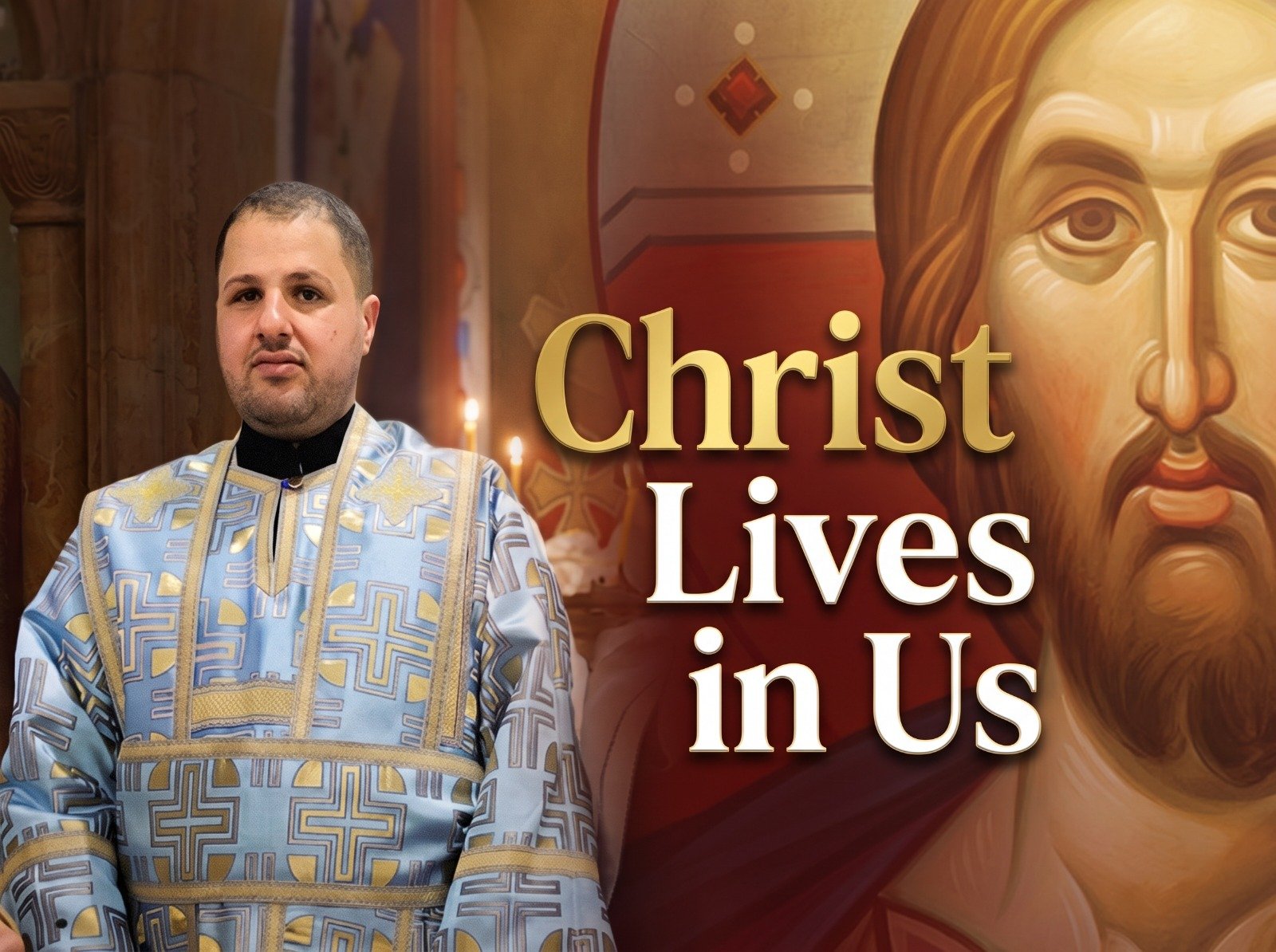
Christ Lives in Us
By: Subdeacon Maximos Al-Sana’a
“I have been crucified with Christ and I no longer live, but Christ lives in me” (Galatians 2:20).
These words sum up the essence of the Christian life: that a person dies to sin, lives in Christ, and enters into true communion with God. This is the mystery of deification in the Orthodox faith. For a human being does not become God in essence, nor is absorbed into Him, but participates by grace in the divine life, becoming a “partaker of the divine nature” (2 Peter 1:4).
“I have been crucified with Christ” means that the old person dies so that the new person may live. In Baptism, we mystically share in Christ’s death and Resurrection, so that we may walk in newness of life (Romans 6:3–4). The Cross, therefore, is not merely about enduring suffering, but about liberation from the dominion of sin and the passions. Christ does not ask us to abolish our personalities or our freedom, but to heal our will and direct it towards God. Just as Christ, through His human will, submitted to the will of the Father in Gethsemane, so too are we called to learn obedience, love and humility (Mark 14:36; Romans 12:2).
As for the words, “It is no longer I who live, but Christ lives in me,” they do not mean that the human person disappears, but rather that the self-centred ego recedes, allowing the new person, formed according to Christ, to become manifest (Ephesians 4:22–24). Christ does not erase our personality, but sanctifies it; He does not abolish our will, but frees it from sin. When Christ begins to live in us, this becomes evident through love, forgiveness, mercy and humility, and not through words alone.
This life is not a human effort independent of God; rather, it is the work of grace and the Holy Spirit within the human person. The Holy Spirit dwells in the believer and makes him a temple of God (1 Corinthians 6:19), leading him to live the life of Christ. Therefore, a person cannot claim that Christ lives in him while remaining enslaved to hatred, pride and sin, for the fruit of the Spirit is manifested in love, joy, peace, long suffering and goodness (Galatians 5:22–23).
This communion with Christ is lived within the Church, His Body, and is not an individual experience detached from it. In Baptism, we put on Christ (Galatians 3:27), and in the Holy Eucharist, we abide in Him and He in us (John 6:56). Through repentance, prayer, watchfulness and spiritual struggle, we respond to the work of grace and grow in communion with Him (Matthew 26:41; 1 Thessalonians 5:17).
Yet the Cross leads to the Resurrection. We do not die with Christ in order to remain in death, but so that we may rise with Him to a new life: “If then you were raised with Christ, seek those things which are above” (Colossians 3:1). Here the true meaning of deification becomes clear: the renewal of human life in Christ, and the gradual transformation of one’s will, mind and love through the grace of God.
How, then, do we know that Christ lives in us? When we learn to forgive rather than seek revenge, to love rather than hate, to be humble rather than seek glory for ourselves, and to resist sin even when no one sees us. Then faith becomes a way of life, and the believer becomes a living witness to Christ in the world (Matthew 5:14–16).
Thus, “Christ lives in me” is not merely a phrase for contemplation, but a call to a complete way of life: a Cross that liberates us from sin, a Resurrection that grants us new life, the Holy Spirit working within us, a Church in which we live as members of the Body of Christ, and grace that leads us towards deification. Our goal is not to lose ourselves, but to find the fullness of our life in Christ, so that we may say with the Apostle: “For you have died, and your life is hidden with Christ in God” (Colossians 3:3).