

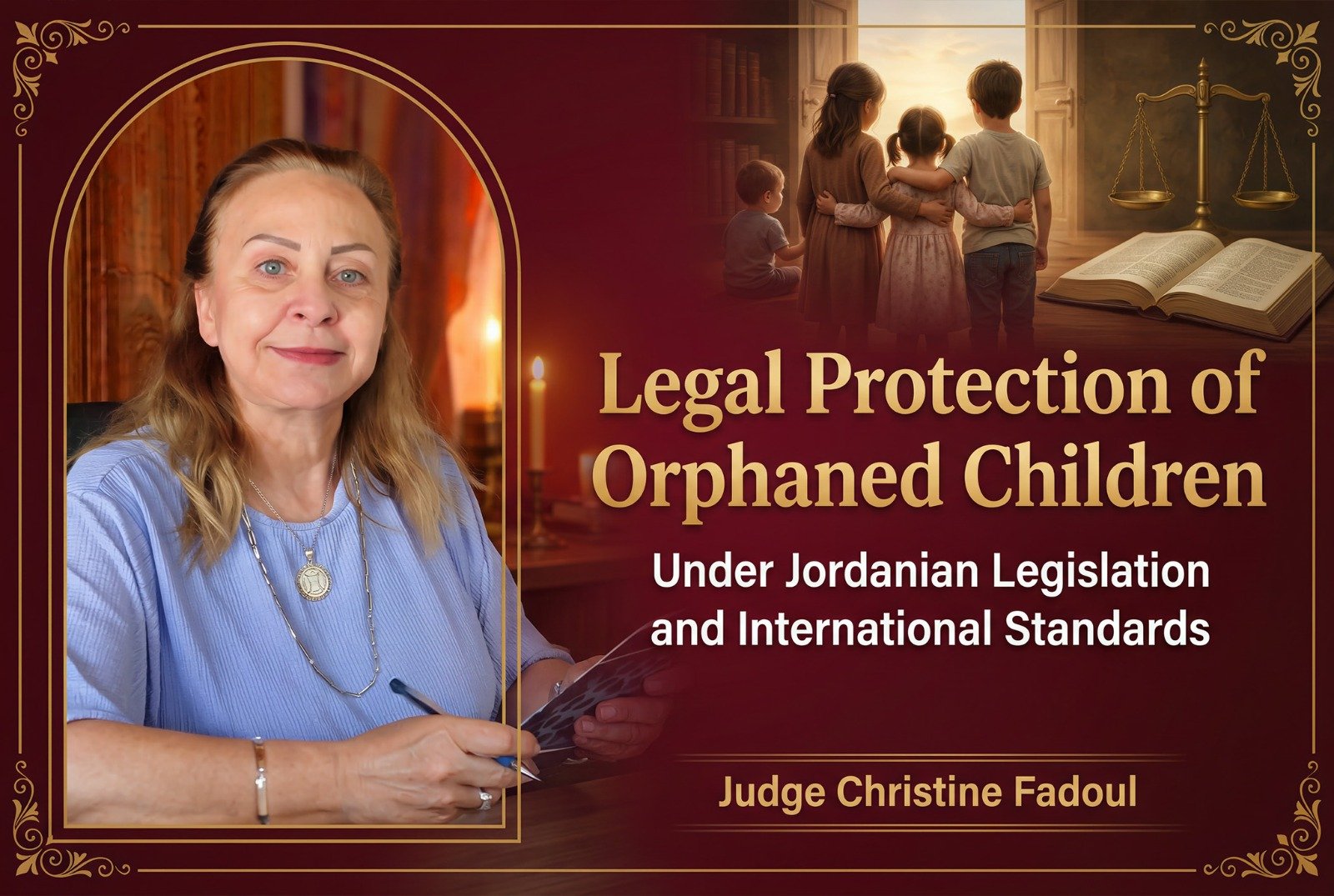
A Research Study Entitled: The Legal Protection of Orphaned Children under Jordanian Legislation and International Standards
Children who are deprived of their family environment, temporarily or permanently, due to circumstances beyond their control, are considered children in need of special protection, care and support provided by the State in the form of basic services under its laws and legislation governing children’s rights, including relevant international conventions.
Alternative care for children deprived of their families takes several forms. These include institutional care, namely children residing in child and orphan care homes; alternative family care, represented by family integration, which involves transferring children from residential care institutions to families qualified to care for them; and the Foster Care System, which is a humanitarian and legal program that enables a family to care for children who have lost their parents, children whose biological families have relinquished them due to certain circumstances, or children of unknown parentage, without attributing the child to the family providing care. One of the conditions is that the foster parents must profess Islam.
As for adoption, it involves taking a child into a family for care and upbringing under specific legal provisions relating to filiation, meaning that the child bears the family name of the adopting family. This system is recognized under Christian religious laws, provided that the family professes the same religion as the child. Adoption is not yet practiced in Jordan, although it is available in certain Arab countries, such as Tunisia and Lebanon, where it is strictly limited to Christian denominations in accordance with their respective personal status laws and through their ecclesiastical courts.
In general, both alternative family care and institutional care must be compatible with and take into account children’s social, legal, cultural and religious circumstances. These elements must be integrated into a comprehensive system, on the grounds that a safe environment is the fundamental common factor for these children, whether they have no biological family or have a family whose continued care poses a threat to their lives and future.
Children deprived of their families are classified into four main categories:
- Orphans: Children who have lost one or both parents through death.
- Children in Need of Protection and Care: Children who experience domestic violence requiring their placement in specialized care centers pursuant to a decision issued by a competent court.
- Children of Unknown Parentage: Children who have been abandoned by one or both parents for socially and humanely unacceptable reasons and for reasons prohibited under religious law.
- Children Residing in Orphan Care Homes.
Legal Overview of Orphaned Children
These are children deprived of their family environment due to the death of one or both parents.
Under Jordanian legislation, guardianship over orphans is divided into two categories: guardianship over the person and guardianship over property.
Guardianship over the person encompasses the child’s care and upbringing, attention to their health and education, provision of a safe environment for their development, fulfilment of their physical and psychological needs, and instilling good values and morals. It relates to the personal affairs of a minor and is exercised by an adult without the need for an appointment order. Such guardianship belongs to the father or mother during their lifetime, or to whoever legally acts on their behalf.
As for guardianship over property, it is a legal and religious authority granted to an adult, namely the father during his lifetime, who is the primary guardian responsible for managing the minor’s assets and disposing of them on the minor’s behalf, including through sale, purchase and investment, in a manner that ensures the preservation and growth of the minor’s assets without causing harm to the minor.
In the event of the father’s death, guardianship over property passes according to the following order of priority: it first passes to the person appointed by the father in his will before his death; then to the father’s testamentary guardian; then to the paternal grandfather, in the absence of a guardian appointed by the father, who is referred to as the designated guardian; and finally to the guardian appointed by the grandfather.
If no such guardian exists, the court appoints a guardian known as a judicial guardian. This may be the mother or an official entity, such as the Directorate of Orphans’ Funds Development.
The mother is entitled to be appointed as guardian over her minor children by submitting an application to the competent Sharia Court, provided that the father has not appointed a guardian himself, there is no natural guardian for the minor (such as the paternal grandfather), or the existing guardian has relinquished guardianship.
In the same context, the Christian Family Law of the Greek Orthodox Patriarchate of Jerusalem of 2023, as amended, derives its provisions from the Byzantine Family Law, whose roots date back to the reign of Emperor Justinian I in the sixth century AD. It is considered one of the oldest bodies of legislation concerned with the religious and moral values of the Eastern Orthodox Church and constitutes the fundamental basis upon which the rules governing personal status, family relations and inheritance were subsequently established.
With regard to guardianship over minors, the aforementioned new Family Law has adopted the same order of priority as the previous legislation concerning guardianship over minors, retaining the following sequence in relation to guardianship and trusteeship:
The guardian designated by the father through a valid will to manage the affairs of and care for his minor children; followed by the mother in the event of the father’s death, with the right to appoint someone to act on her behalf through a will. In the absence of a designated guardian and/or the child’s mother, the Orthodox Ecclesiastical Court appoints a designated guardian by judicial decision, in a manner that serves the best interests of the minor.
In the Catholic Church, priority is given to the guardian designated by either parent during their lifetime, followed by the statutory guardian, appointed by one of the parents (the surviving parent), who may be the mother, provided that she has not remarried. This is followed by the court-appointed guardian, namely the person or entity appointed by the Ecclesiastical Court in the absence of a designated or statutory guardian.
In general, all officially recognized churches in Jordan have similar legal systems for protecting the rights of minor children, particularly orphans. Children’s rights are safeguarded within a general framework established by the Jordanian legislator through legislation governing family affairs and personal status matters in general, without any discrimination on any grounds whatsoever. According to the Jordanian Constitution, Jordanians shall be equal before the law, there shall be no discrimination between them as regard to their rights and duties on grounds of race, language or religion (Article 6(1)).
Legal Protection of Orphans in Cases Where They Have Lost Their Father, Mother or Both Parents
Jordanian legislation governing the rights of orphaned children in the Hashemite Kingdom of Jordan protects their personal, legal and institutional affairs, where necessary, as follows:
1. Legislation Governing Personal Status (Sharia or Ecclesiastical):
This includes all matters relating to orphaned and minor children, in addition to the relevant civil laws, all of which fall within a unified national framework, namely the best interests of the child.
In all circumstances, the actions of a guardian or trustee are restricted by law, particularly with regard to transactions involving the sale, purchase or investment of assets, which require the authorization and approval of the court (the Sharia or Ecclesiastical Judge).
As for living expenses, including food, clothing, drinking water, education and medical treatment, if the orphan or minor has personal assets of their own (meaning that they have inherited from their parents or from either of them), such expenses are paid from their own assets, regulated by the court and allocated to the person appointed by either parent or the person legally responsible for the child. The actions of that person remain subject to the court’s supervision.
However, if the child is poor and has no assets, the obligation to provide maintenance falls upon financially capable relatives, such as the paternal grandfather, paternal uncles, the mother, or the person legally responsible for the child, pursuant to a court ruling and in accordance with Sharia or ecclesiastical rules.
Personal Status Laws (Sharia and ecclesiastical) regulate the care of orphaned children in matters relating to custody, visitation and the right to receive visits, ensuring that family ties are not severed. The primary consideration is the protection of their family, social, moral and psychological rights, ensuring that they are raised and develop in a sound environment and, God willing, have a bright future.
2. Protection from Domestic Violence Law No. (15) of 2017:
This legislation aims to strengthen family cohesion and stability and protect families against all forms of abuse and violence through specific and carefully considered protection measures designed to protect either or both spouses, in order to promote family and community stability. It focuses on reform and behavioral modification rather than relying solely on punitive measures.
This Law also protects relatives up to the third degree, relatives by blood and marriage, provided that they reside in the family home, as well as children under custody and alternative families.
The primary purpose of including alternative families is to ensure protection and provide a safe environment for children who are victims of violence within alternative families, where such families exist. It should be noted that the alternative family program aims to provide foster care for orphans and children deprived of family support.
3. Ecclesiastical Legislation:
With regard to ecclesiastical legislation, His Excellency Prime Minister Dr Jaafar Hassan approved, on October 11, 2026, a draft law amending the Law on Councils of Christian Denominations of 2014/2026, in preparation for its submission to the House of Representatives for approval in accordance with constitutional procedures.
The draft law amends the wording of Article (4) of the original Law, which concerns specifying, clarifying and adding to the jurisdiction of the ecclesiastical courts recognized in the Hashemite Kingdom of Jordan. These jurisdictions cover four specific areas, namely marriage, divorce and all related matters, which have been and continue to be handled by the councils of Christian denominations (ecclesiastical courts). Adoption and wills have also been added to their jurisdictions as additional areas of competence.
It should be noted that the aforementioned Law is a unified ecclesiastical law applicable to all churches in the Kingdom. It passes through the legislative and administrative channels in accordance with the Jordanian Constitution, which grants legal authority and force to the relevant personal status legislation of each officially recognized denomination separately, pursuant to Article (109) of the Jordanian Constitution.
4. Convention on the Rights of the Child:
Article (20) of the Convention stipulates that a child who is temporarily or permanently deprived of his or her family environment shall be entitled to special protection and assistance provided by the State, as well as the provision of alternative care. Such care may take several forms, including Kafala as provided for under Islamic law (foster care), adoption, or placement in care institutions.
Article (21) of the Convention addresses regulatory matters relating to the adoption of children and alternative care for children deprived of family care. Such matters are handled through the competent official and judicial authorities, which verify the circumstances of the child and their relatives in accordance with applicable laws and procedures.
In 1991, Jordan entered reservations to both of these Articles. In its periodic annual reports on the human rights situation in the Kingdom, the National Centre for Human Rights recommended the withdrawal of these two reservations, on the grounds that the aforementioned Articles address the right of a child deprived of their family environment to alternative care, including Kafala under Islamic legislation or adoption, while taking into consideration the child’s religious background in their upbringing. This is particularly important given the child’s right to special protection and assistance provided by the State. Such measures must be authorized by the competent authorities, which establish the relevant standards through appropriate conditions and safeguards to ensure that the child grows up in a family environment similar to the one from which they originated.
Legal Overview of Children in Need of Protection and Care
Jordanian law defines a child in need of protection and care as a person under the age of eighteen who is experiencing difficult family, social or environmental circumstances that threaten their physical, psychological or moral well-being and may lead them into delinquency, without having committed an offense punishable by law.
Article (33) of the Jordanian Juvenile Law No. (32) of 2014 specifies the circumstances that necessitate State intervention to protect these children. These circumstances are essentially characterized by the absence of a suitable natural family environment capable of caring for them due to the conduct of their parents or caregivers, such as their habitual engagement in criminal activities or moral depravity.
The presence of children belonging to this category within their families may expose them to direct and intentional abuse or violence by their parents, exceeding the limits of disciplinary measures permitted by law. They may also face a grave, serious and immediate risk if they remain within their biological families. This may necessitate separating them from or removing them from their families, thereby leaving them without parental care despite the existence of their parents. Such circumstances require State intervention and their placement in specialized care centers pursuant to a judicial decision and on the basis of an assessment submitted by the Social Services Offices affiliated with the Ministry of Social Development.
This is intended to protect them from their current environment. The court’s decision is based on the best interests of the child, and placement decisions are subject to continuous review by the court and the relevant supervisory authorities to ensure that children do not become delinquent and that they develop in a sound and stable environment, despite having biological families, as their existing environment poses a risk to them and their future.
Legal Overview of Children of Unknown Parentage
These are children who have been abandoned by one or both parents due to compelling circumstances, such as poverty, family disintegration, lack of family supervision, or unlawful relationships that often result in the abandonment of a pregnancy outside marriage.
Under Jordanian law, children whose parentage from both parents is unknown are treated as citizens enjoying full rights. The State grants them Jordanian nationality, healthcare and education, and official documents and a personal identification card are issued to them bearing fictitious four-part names through the Civil Status and Passports Department, in coordination with the Ministry of Social Development, as the primary authority responsible for their care and for providing them with institutional care and alternative family care, in addition to education, medical treatment and other services.
The parentage of these children may be established through all means of proof recognized by law, including DNA testing.
The same provisions apply to children whose paternal parentage is unknown while their mother is known. In both cases, the right to establish parentage remains open.
Children of unknown parentage do not inherit from their parents unless their parentage is established by judicial or religious means.
Children of unknown parentage may be placed in foster care under the supervision of the Ministry of Social Development. In certain cases, the alternative family may bequeath part of its estate to the orphaned child under its care (the foster child), through a will, within the limit of one-third of the estate, since the child is not a lawful heir under the provisions of Islamic Sharia.
Children of unknown parentage profess the religion of the State, namely Islam, unless their parentage is established in relation to their father or (both parents), who belong to another religion.
Legal Overview of Children in Orphan Care Institutions
The protection of orphaned children and children deprived of family support in care homes and institutions in Jordan is based on the Social Development Law No. (4) of 2024, from which binding regulations and instructions derive. The most prominent of these are the Regulation on the Licensing and Management of Residential Child Care Homes and the Alternative Care Regulation.
These constitute legislative, regulatory and legal frameworks for protecting this category of children. They are generally centered on providing a safe environment for children deprived of family support and ensuring their fundamental rights, including education, healthcare, nutrition and protection against violence and abuse. They also establish requirements relating to capacity and the qualifications and standards that supervisors and childcare providers must meet.
The primary objective of the Alternative Care Regulation is to facilitate a gradual transition from institutional care (orphanages) to alternative family care, in addition to establishing stringent procedures for continuous monitoring and inspection by the Ministry to ensure that children are not subjected to any form of abuse.
There are twenty residential childcare homes distributed across the Kingdom’s governorates. Four (4) of these are government-run homes managed by the Ministry of Social Development, while sixteen (16) are operated by voluntary civil society associations and institutions that provide outstanding services to hundreds of children deprived of family care, under the supervision of the Ministry of Social Development.
In this context, Um Al-Hussein Welfare Home is considered a pioneering institution in caring for orphans and children deprived of family support in Jordan. It was established in 1958 by the late Her Majesty Queen Mother Zein Al-Sharaf. This home is regarded as a safe haven for orphaned children and those facing difficult family circumstances.
Similarly, the non-profit organization SOS Children’s Villages provides alternative family care through homes designed to resemble real family settings, with the assistance of substitute mothers, in villages located in Amman, Irbid and Aqaba.
The St Vincent de Paul Charitable Society, established in 1957 in the capital, Amman, is also regarded as a leading humanitarian institution providing care and shelter for orphaned children and children in need of protection and care, within a framework of coexistence and social solidarity. It provides children with the means to live a dignified life, including education, healthcare, food and clothing, in addition to cultural and recreational activities.
In 2006, a childcare home was inaugurated in the city of Anjara. It provides orphaned children with residential care, educational services, humanitarian assistance, recreational activities and educational programs in Anjara, in Ajloun Governorate, within an atmosphere of human fraternity, love and belonging.
It should be noted that both the St Vincent de Paul Charitable Society and the Anjara Orphanage operate under the auspices and direct supervision of the Catholic Church in Jordan.
The Religious and Moral Importance of Caring for Orphans
The categories of children deprived of their families are considered orphans in the legal, factual and social sense. The loss of one or both parents does not necessarily occur only through their actual death, as is commonly understood. Rather, the absence of parents from their children’s lives constitutes a genuine and actual loss that children endure throughout their lives.
Regardless of the reasons for the parents’ absence, children retain rights that must be respected by those responsible for them and by decision-makers, as this constitutes a shared and collective responsibility from legal, social, humanitarian and even religious perspectives.
Care homes protect these children from being lost, falling into delinquency and poverty, while the relevant Jordanian legislation safeguards their financial and personal rights. This is in addition to family protection programs, such as family integration and the Islamic Kafala system, which contribute to promoting the values of compassion and solidarity among members of society and supporting children deprived of their families, subject to specific legal conditions.
In order to achieve social solidarity and equality among all segments of Jordanian society, without discrimination on the basis of race, language or religion, as stipulated in the Jordanian Constitution, we hope that an adoption system/law will be adopted, as adoption is a religious and humanitarian duty aimed at preserving the dignity of the child and their legitimate right to live within a Jordanian Christian family, on an equal footing with other children deprived of family care.
Prepared by: Judge Christine Fadoul
References:
- The Jordanian Constitution.
- The Convention on the Rights of the Child.
- Personal Status Law No. (15) of 2019.
- Christian Family Law of the Greek Orthodox Patriarchate of Jerusalem of 2023.
- The Legal Journal Law of 1983.
- Personal Status Law of the Eastern Catholic Churches.
- Jordanian Juvenile Law No. (32) of 2014.